Energy optimisation
Prioritise the investments that create the most value
Envo works through every property on its actual consumption and finds the combination of measures that reaches your target for the least money. That has meant 17–33% lower investment for the same target.*
Free 14-day trial for businesses and public authorities.
For property companies, pension funds and municipalities
* Calculated in optimisations on the Envo platform and compared with the energy label's recommendations and engineers' solutions. Results depend on the building and your targets.
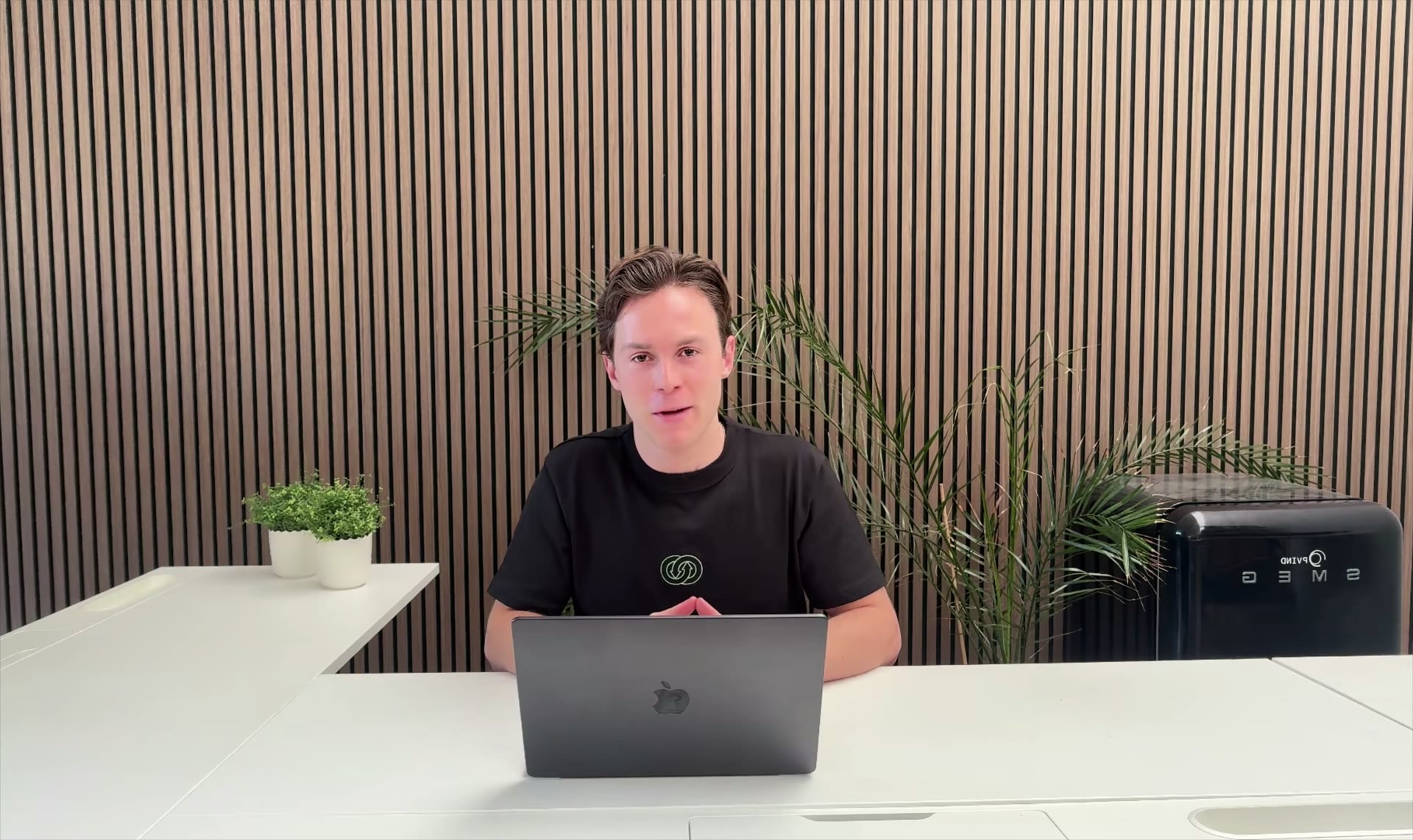
See the module in use
2:33Used by property companies, pension funds and municipalities








Results from the platform
Better decisions. Greater property value.
17–33%
lower investment
than the energy label's recommendations and engineers' solutions, for the same target
10 minutes
instead of 1–3 months
per property screening
One
quality-assured data foundation
BBR, energy labels, Eloverblik and utilities
+7 yrs
longer below the Reduction Pathway
in one customer project
4
comparable scenarios
per property
The figures are based on historical optimisations on the Envo platform and customer use cases. Results depend on the building and your targets.
Envo combines the measures into one optimal plan
Every type of measure is assessed together for the building. The measures that reach the target at the lowest total cost are chosen and placed in time. The rest are rejected, with a reason.
Assessing combinations
Choosing measures
Plan ready
Tap a measure to see the details
- Investment
- 0.0
- m DKK
- Annual saving
- 0
- DKK/yr
- Payback
- –
- yrs
- Energy label
- E
- target B
Example: 1,061 m² mixed commercial and residential, central Copenhagen. Measure data and the split per measure are illustrative; the totals are from the calculated plan.
The challenge
Measures must be assessed together, not one by one
EPBD and EED set requirements and frameworks for how buildings must develop in energy and climate performance. That calls for a long-term plan for investments in the building envelope, heating supply and renewable energy. A low renovation rate makes prioritisation all the more important.
Thousands of possible solutions. One is the cheapest that meets the requirement.
Each point is a possible renovation plan for the same building. A manual screening assesses a few, and often ends with an acceptable but not optimal solution.
- Possible solution
- Does not meet the requirement
- Technically impossible
- Traditional prioritisation
- Optimal solution
Illustrative example
Data-driven energy management
From portfolio to investment plan
Three steps in the platform. Most of the data is fetched automatically, so you spend the time on the decisions.
01 / 03
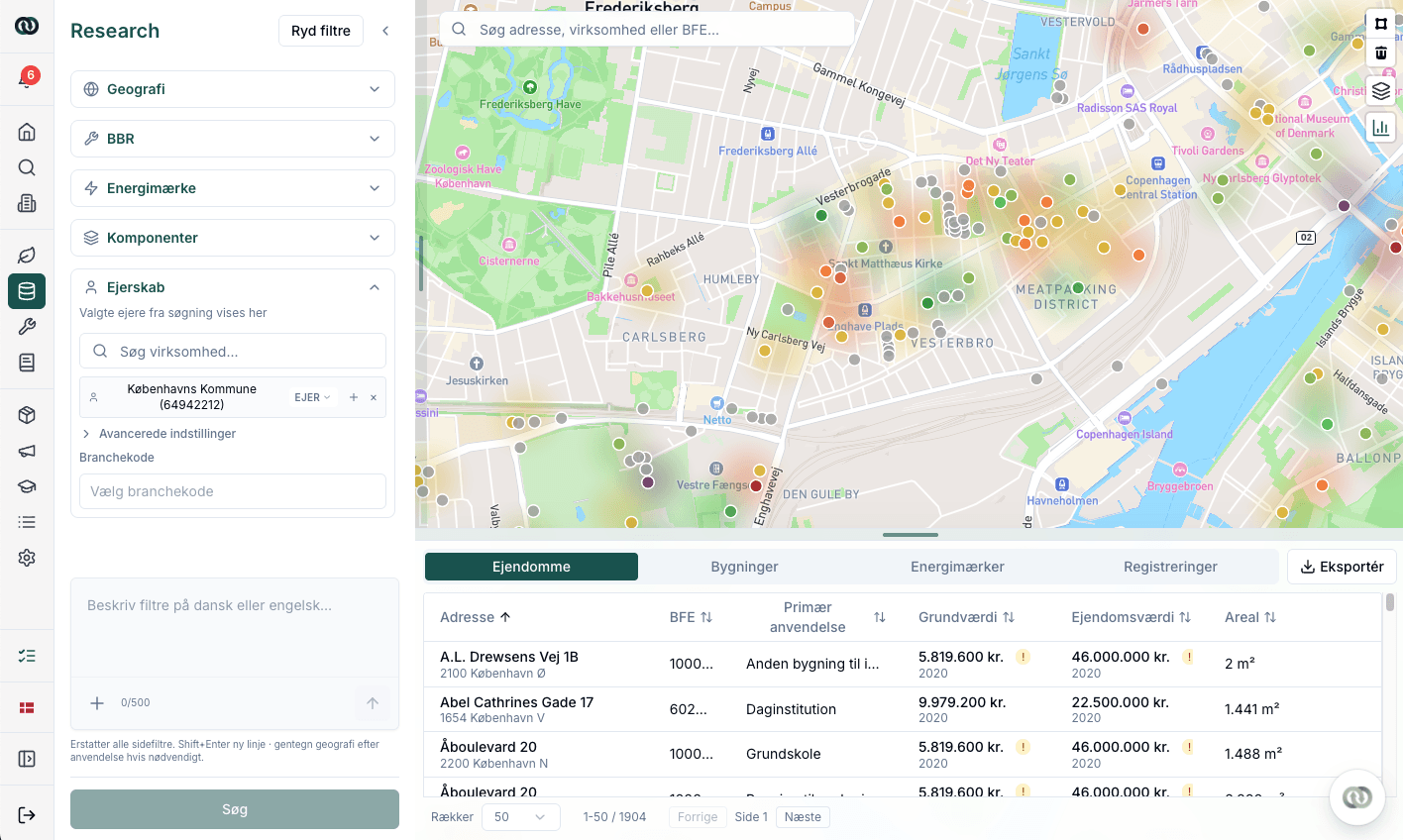
Load portfolio and consumption
Enter addresses or import your portfolio. Envo fetches BBR data and energy labels automatically and quality-checks them. Add actual electricity and heat consumption from Eloverblik, utilities or your EMS, so the building model is calibrated to real consumption.
Data from public registers, maps from Mapbox and import from Excel
02 / 03
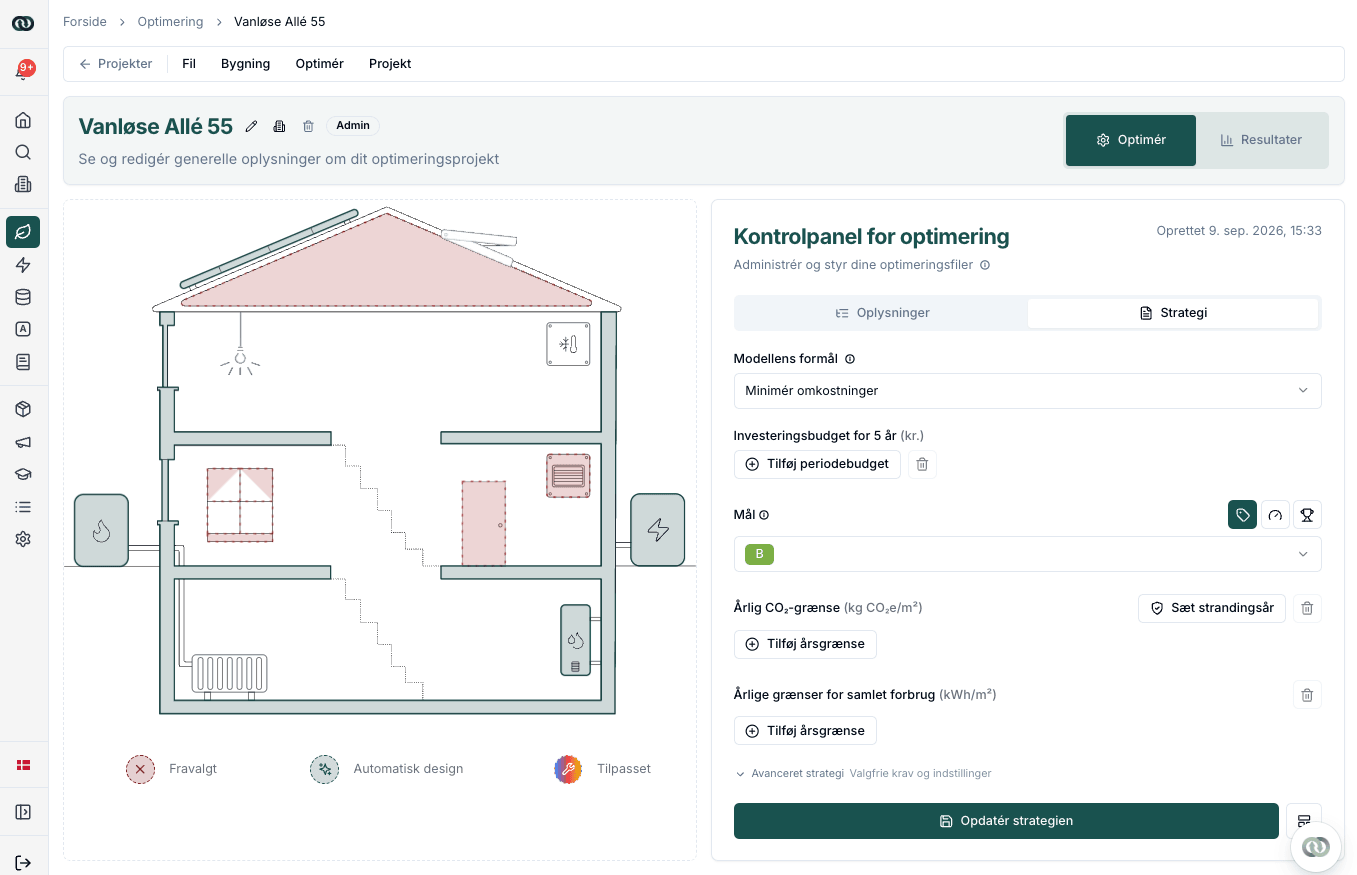
Screen solar PV and set up your strategy
Solar potential is calculated per roof surface, accounting for shading, pitch and orientation. Then choose a target (energy label, SBTi, EU taxonomy or a CO₂ limit), investment budget per period and your own renovation packages and prices. Save the setup as a template for the whole portfolio.
03 / 03
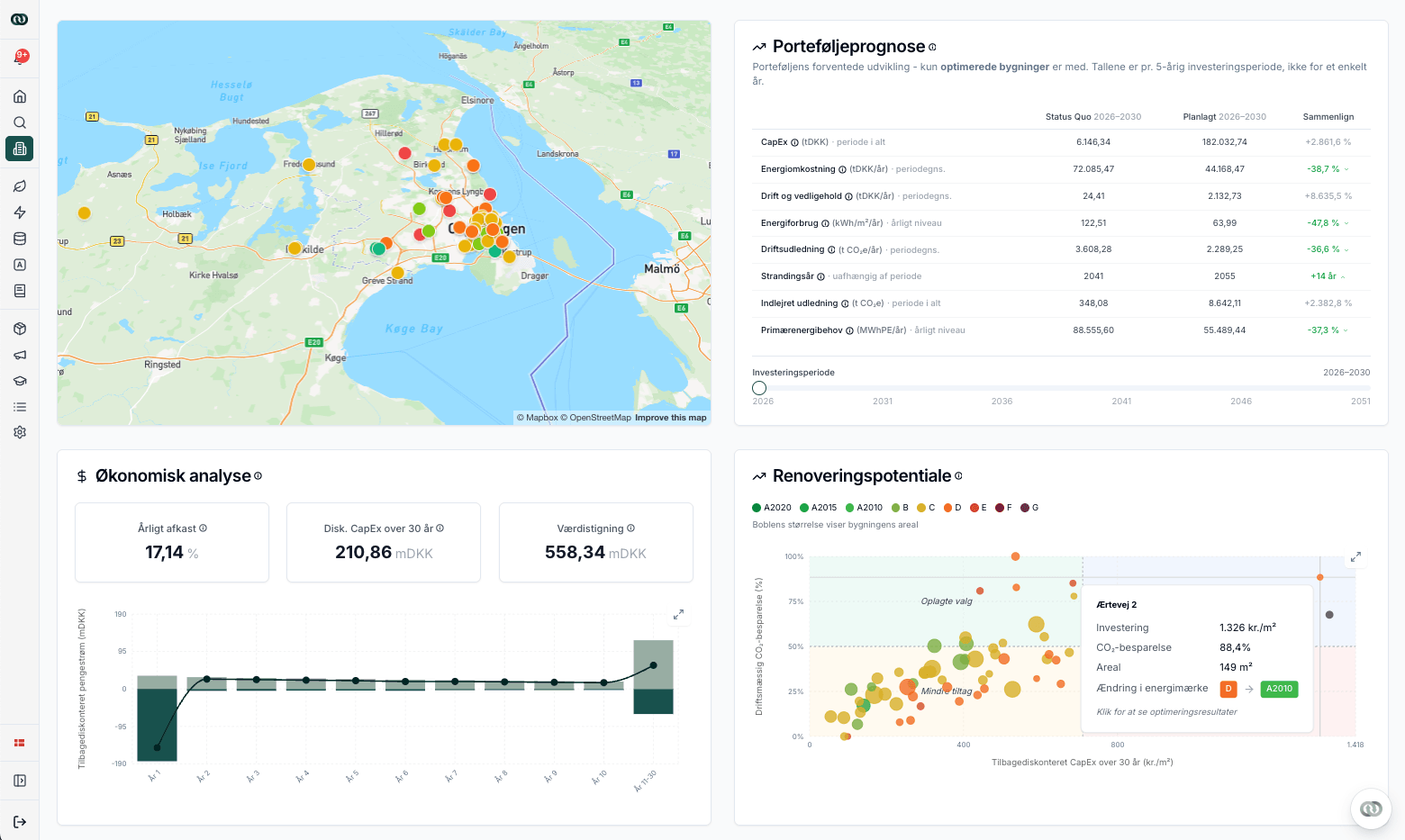
Get results for portfolio and buildings
Envo calculates the plan that reaches the target at the lowest cost: measures per period, cash flow, CO₂ pathway and energy label before and after, for every building and for the portfolio as a whole. Export to PDF, Excel and DGNB.





Transparent and reproducible calculations
The calculations use classic engineering methods and optimisation algorithms, not language models or statistical models without explanatory power. The same input gives the same result, and every calculation can be documented to the board, auditors and authorities.
Calculate for your own property
Enter the address and it will be ready when you have created a free account.
What does it mean for your portfolio?
An estimate from your numbers. Adjust the assumptions to fit you.
Same target, about DKK 54m lower total cost
- Renovation investment
- Screening and advisory
- Internal time
- With Envo
51.0 m DKK
lower renovation investment
same target, 17% lower investment
2.7 m DKK
saved on screening and internal time
consultant fees and data collection
10.5 m DKK
energy saving to the owner
35% of the saving over 10 years
1,280 hours
internal time freed up
minutes vs 1–3 months per property
Estimate. The Envo licence is not deducted.
Results
One method across the whole portfolio
The calculations run for the whole portfolio with the same assumptions. That shows which properties meet the targets, which can be lifted with limited investment, and where the CO₂ reduction per krone invested is greatest.
We use Envo both to find optimisation potential in our existing properties and as part of our due diligence. Energy labels and actual consumption data are in one place, which has saved us time, and we can optimise across our portfolio and get a far better basis for prioritising our CapEx investments.

Mikael Toftegaard Sahlin Olesen
Urban Partners
Measures affect each other's impact and economics
Insulation reduces the heat pump capacity you need, and solar PV is worth more with electric heating. A list sorted by payback does not see that interplay.
| Insulation | Windows | Heat pump | Ventilation | Solar PV | Lighting | |
|---|---|---|---|---|---|---|
| Insulation | Same measure | |||||
| Windows | Same measure | |||||
| Heat pump | Same measure | |||||
| Ventilation | Same measure | |||||
| Solar PV | Same measure | |||||
| Lighting | Same measure |
- Independent
- Mild
- Medium
- Strong synergy
Tap a cell to see the interplay
Heat pump × Solar PV
↑↑↑ Strong synergy
Solar PV is worth more with electric heating, because more of the power is used in the building.
The traditional prioritisation
Measures are sorted by payback and the quickest is chosen first. A fine first approach, but it misses the interplay.
- 1Lighting2.5 yrs
- 2Solar PV4 yrs
- 3Ventilation7 yrs
- 4Heat pump9 yrs
- 5Windows12 yrs
- 6Insulation15 yrs
Questions
Frequently asked questions
What is data-driven energy management?
Data-driven energy management means that decisions on operations and investments are based on actual consumption and quality-assured data rather than standard figures and one-off screenings. Envo brings together energy labels, BBR data and consumption from Eloverblik, utilities or your EMS for the whole portfolio, and uses them to calculate which investments create the most value.
What data is needed to get started?
The addresses are enough. Data from BBR, energy labels and climate data is fetched automatically. Actual consumption data from Eloverblik and utilities improves precision and can be added as you go.
How long does a calculation take?
Optimising a property takes a few minutes. A whole portfolio can be calculated with the same assumptions in one go, instead of 1–3 months per property with a traditional screening.
How accurate are the results, and how are they validated?
The building model follows principles from ISO 52000 and is calibrated against actual electricity and heat consumption. The energy label is quality-checked, and automatic data checks run before the calculation.
How does energy optimisation relate to Envo's energy monitoring (EMS)?
Energy monitoring is Envo's EMS: it follows consumption in operation, raises alarms on deviations and finds savings in the existing systems, typically estimated at 8–20%. Energy optimisation plans the investments in the building that EPBD and EED require, typically estimated at 30–50%. Both sit in the same platform on the same data: measured consumption calibrates the plan, and afterwards you can follow what each measure saves.
Does Envo use artificial intelligence?
The optimisation uses classic engineering methods and optimisation algorithms, not language models, so the same input gives the same result and every calculation can be verified. Language models (Envo AI) are used to read documents and write explanations and drafts, which you approve.
Can we use our own prices, renovation packages and suppliers?
Yes. You can create your own renovation packages and prices, exclude invasive measures, and require or exclude specific measures in specific years. The setup can be saved as a template for the whole portfolio.
Do the calculations account for listed and conservation-worthy buildings?
Yes. Listing and conservation value are constraints in the optimisation, so the plan only proposes measures that are compatible with the registered restrictions. Permits are applied for as usual.
Can the results be used in reporting and shared with consultants?
Yes. Results can be exported to PDF, Excel and DGNB and shared with consultants, the board and auditors.
How does pricing work?
The price depends on the size of the portfolio and the modules you use. See the prices, or book a walkthrough and we will run the numbers on your portfolio. See pricing
Get a decision basis for your first property
Try the platform for free, or book a walkthrough where we run the numbers on one of your properties.
Free 14-day trial for businesses and public authorities.